The Best Blue for Watercolor Portraits? I Tested 3 Popular Options

If you own watercolor paint sets, you’ve probably used phthalo blue green shade at some point. It comes in many basic watercolor palettes and is known for being incredibly powerful and vibrant.
But recently, I borrowed a book from Japanese artist Aoe Kenji, who builds much of his palette around phthalo blue red shade instead. Around the same time, I attended the Portrait Society conference where watercolor artist Mary Whyte spoke about using ultramarine blue in skin shadows.
Three completely different blues.
Three completely different approaches to painting skin.
So I decided to test them.
I painted the same portrait three times using the same limited palette setup, only switching the blue each time.
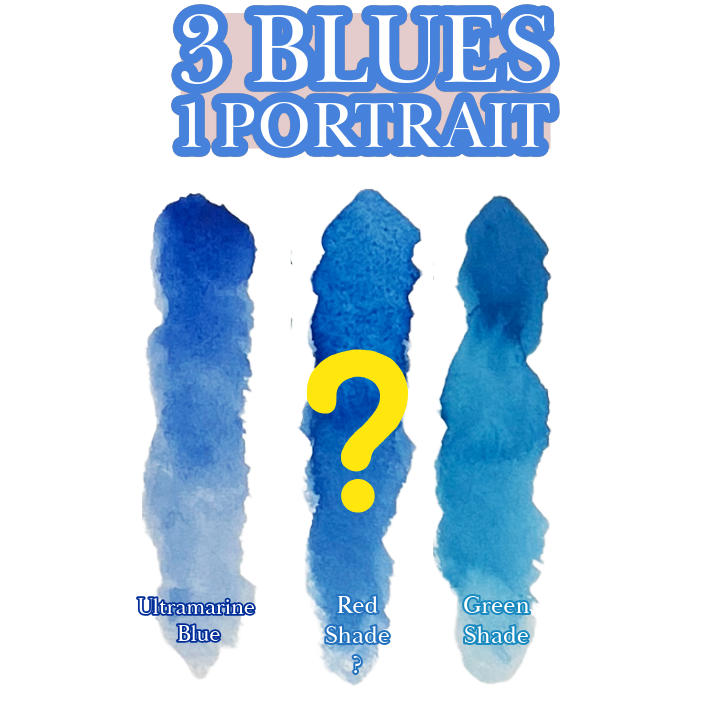
The Palette
The red and yellow stayed the same throughout the test:
PR254 — Pyrrole Red
PY154 — Yellow (I used Winsor Yellow)
The blues tested were:
PB29 — Ultramarine Blue (I used Schmincke Ultramarine Finest)
PB15:3 — Phthalo Blue Green Shade (Daniel Smith)
PB15 RS — Phthalo Blue Red Shade (Daniel Smith)
I wanted to keep the experiment as controlled as possible so the behavior of each blue would become more obvious.

1. Ultramarine Blue (PB29)
Ultramarine created the most natural-looking shadows overall.
The mixtures leaned beautifully into soft violets and muted skin tones, which felt very believable and elegant for portrait work. It also felt the most forgiving while painting.
I understand now why so many portrait artists naturally gravitate toward ultramarine. The shadows feel atmospheric rather than artificial.
That said, ultramarine is less punchy than phthalo blue and doesn’t create the same intensity or chroma.
2. Phthalo Blue Green Shade (PB15:3)
This was by far the strongest and most intense blue of the three.
The greens mixed with yellow were extremely vibrant, and even a tiny amount of paint went a very long way. The resulting portrait had a much more dramatic and high-contrast appearance.
But this also made it the easiest blue to push too far.
In skin tones, phthalo blue green shade can quickly start feeling artificial if not controlled carefully. It creates a very modern, punchy look, but it requires restraint.
3. Phthalo Blue Red Shade (PB15 RS)
This ended up being the biggest surprise of the test.
Phthalo blue red shade felt like a balance between the other two options. It still had the vibrancy and strength of phthalo blue, but the mixtures felt more controlled and usable for portrait work.
The violets were richer and deeper, while the greens became more earthy and balanced compared to the green shade version.
Out of all three, this was the blue that felt the most versatile overall.
If I had to choose one to continue exploring in future portraits, it would probably be this one.
What Surprised Me Most
One thing I didn’t expect was how difficult it became to mix deep neutral browns with this high-chroma primary palette.
Everything wanted to stay vibrant.
That created beautiful color variation, but it also meant I had to work harder to neutralize mixtures for darker skin tones and deeper shadow passages.
Even so, the differences between the blues became very clear by the end of the experiment.
Final Thoughts

I originally expected ultramarine to remain my favorite because it already plays such a large role in my portrait work.
But after doing this comparison, phthalo blue red shade genuinely surprised me. It offered both vibrancy and control in a way that felt especially useful for watercolor portraits.
At the same time, I can completely understand why many portrait artists continue to prefer ultramarine for its softness and natural violet shadows.
In the end, I don’t think there’s one perfect blue.
Different blues create different emotional atmospheres in portraits — and that difference became much more obvious once I painted the same face three times.
You can watch the full comparison and painting process here:
[Embed YouTube Video Here]