Reimagining Monet: What I Learned Mixing Watercolor and Drawing Oils
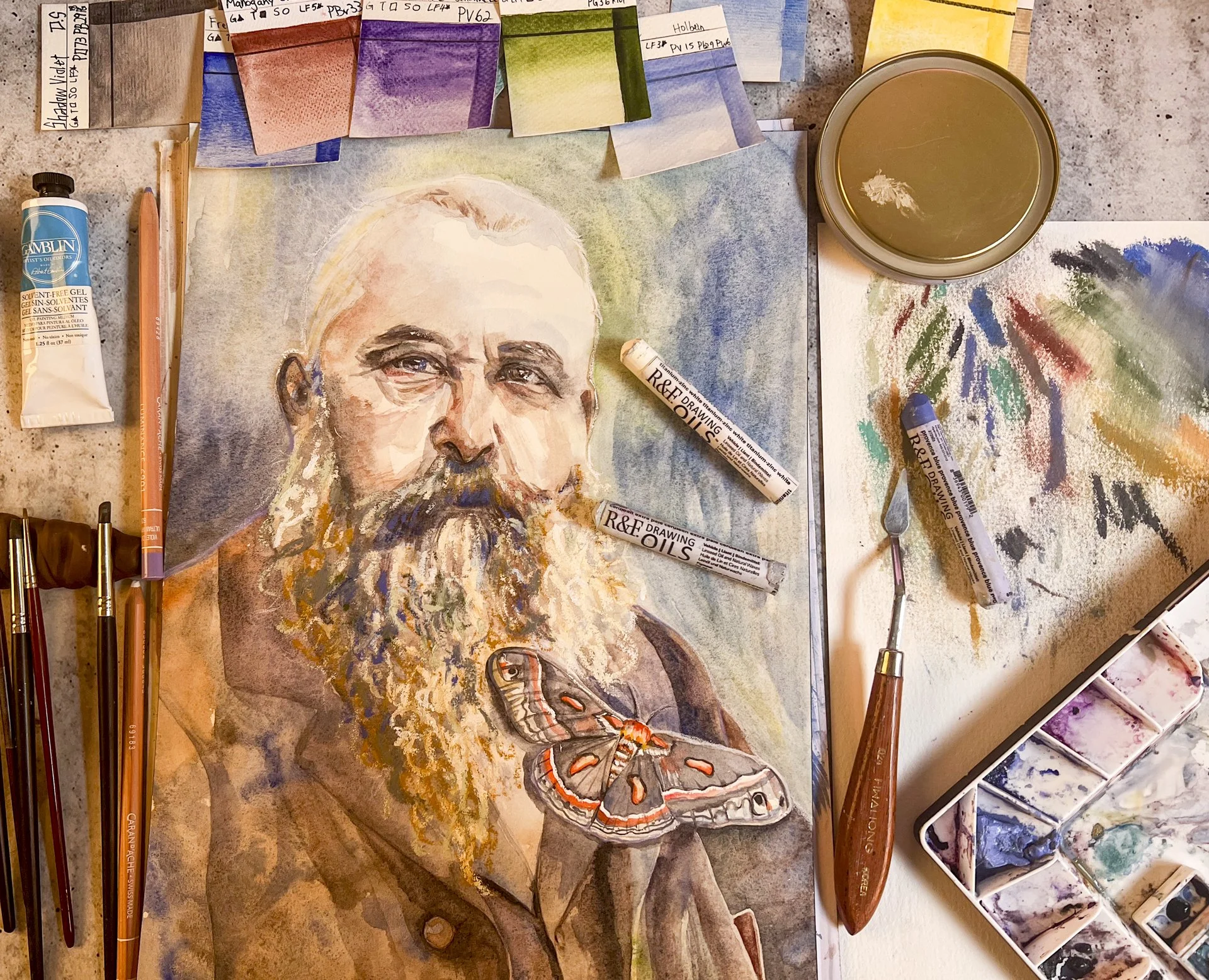
There’s a reason painters are taught early on that oil and water don’t mix.
It’s a rule meant to protect the work. To prevent failure before it happens.
And yet, every so often, a rule starts to feel less like guidance and more like a wall.
This painting began with that feeling.
The Rule I Wanted to Understand
I’ve worked in watercolor long enough to know its limits. I also know its generosity. It forgives, but only if you listen. It stains, spreads, and remembers every choice you make.
Oil, on the other hand, is usually framed as watercolor’s opposite. Slow. Opaque. Demanding a different kind of patience.
Mixing the two is rarely encouraged, especially on paper.
But curiosity has a way of resurfacing when you sit with it long enough. I wasn’t interested in breaking the rule for novelty’s sake. I wanted to understand why it existed, and what might happen if I approached it carefully.
Why Monet
Claude Monet felt like the right artist to hold this question.
His work isn’t about precision or control. It’s about atmosphere, repetition, and sensation. About returning to the same subject again and again, knowing it will never be the same twice.
If there was a painter who understood uncertainty as part of the process, it was him.
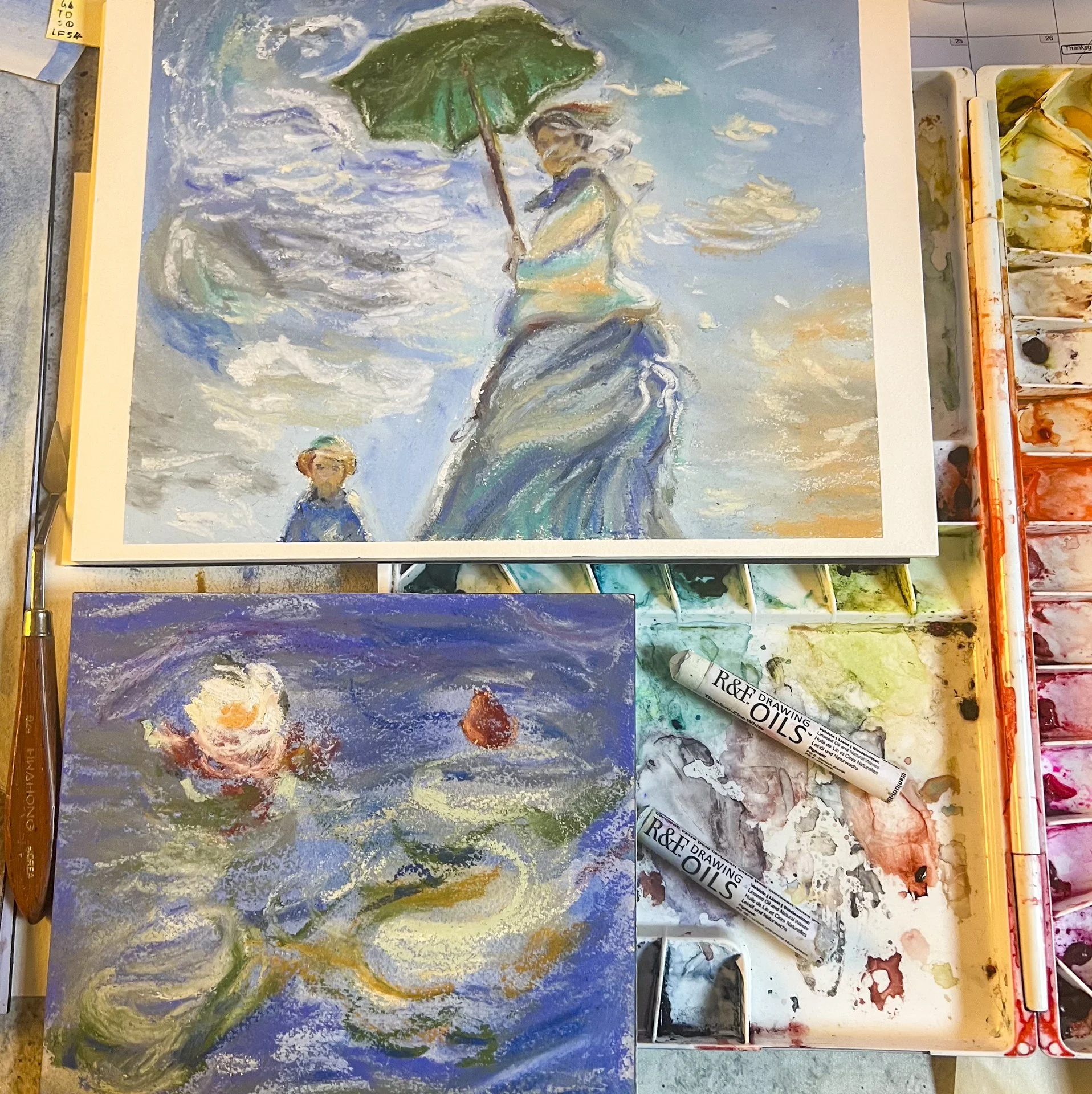
Rather than copying a specific painting, I treated Monet as a lens. A way of thinking about color, movement, and surface rather than outcome.
The Moment of Risk
I began with a watercolor base, letting the color move freely. Soft transitions. No hard edges. The kind of foundation that feels alive but fragile.
Then came the moment I’d been circling.
Applying transparent gesso over watercolor is not neutral. It changes the surface immediately. The paper becomes less absorbent, less predictable. I didn’t know whether the underlying washes would lift, dull, or disappear altogether.
That uncertainty was the point.
I wanted to feel what it was like to move forward without reassurance. To stay present instead of trying to control the result before it arrived.

What Actually Happened
The watercolor held, but it changed.
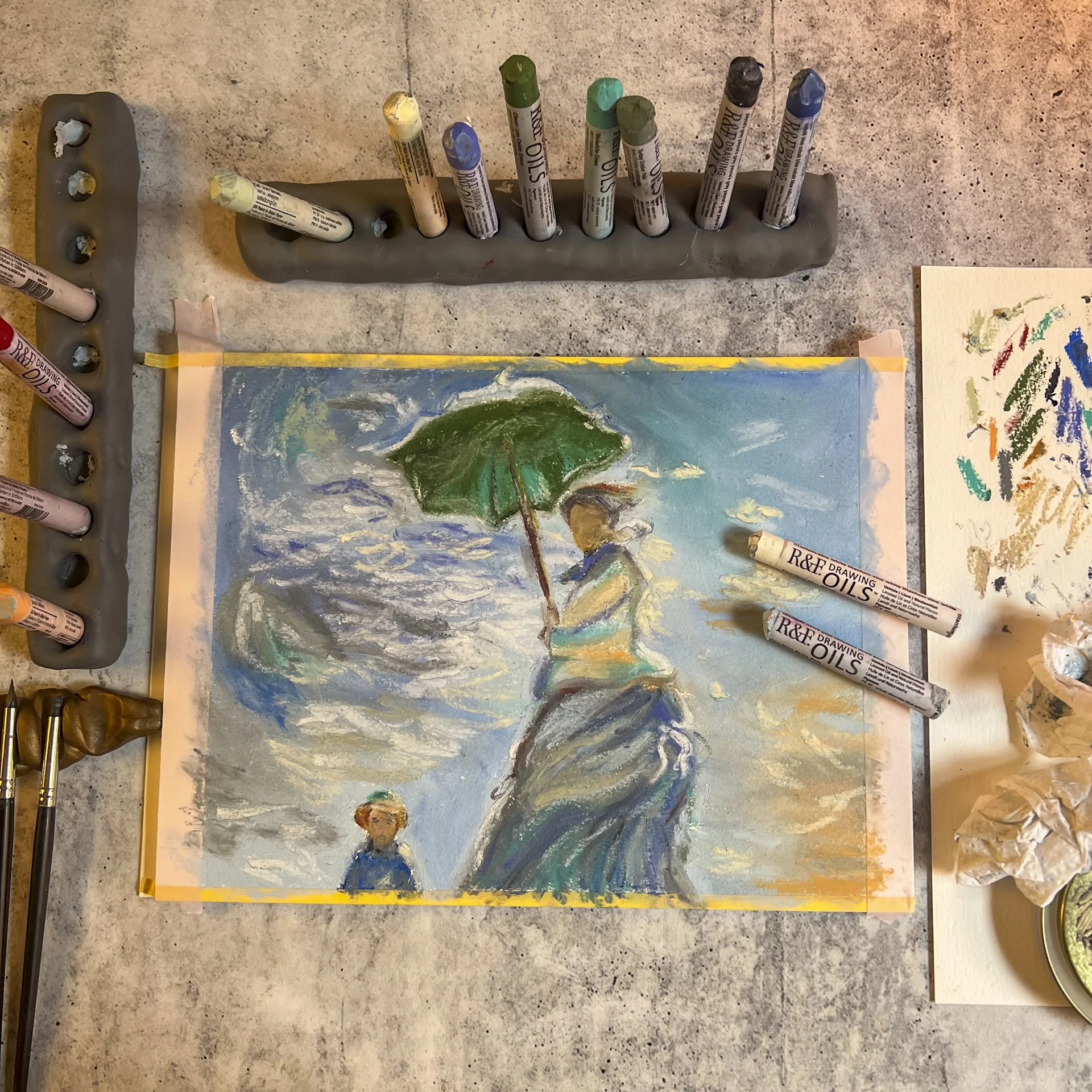
Once the gesso dried, the surface resisted in a way plain paper never does. When I introduced R&F Drawing Oils, the marks sat differently. They didn’t sink in. They hovered. Blended slowly. Refused to behave like either medium on its own.
Some areas surprised me with their luminosity. Others felt tense, even awkward.
Not everything worked. But nothing felt wasted.
What Shifted for Me
This experiment wasn’t really about Monet, or even about materials.
It was about fear. The kind that shows up as caution, and the kind that disguises itself as discipline. About how often we avoid trying something not because it’s wrong, but because we don’t yet understand it.
Mixing watercolor and drawing oils didn’t give me a new formula to follow. It gave me something quieter: a better sense of when a rule is serving the work, and when it’s simply protecting my comfort.
What I’m Carrying Forward
I don’t plan to combine these materials all the time. Some rules exist for good reason.
But I do plan to listen more closely to the moments when curiosity persists. When a question keeps returning, even after I’ve told myself it’s impractical.
Reimagining Monet reminded me that experimentation doesn’t have to be loud to be meaningful. Sometimes it’s enough to sit with uncertainty, make the mark anyway, and see what remains.
Related
🎥 Watch the full studio experiment:
I Combined Watercolor and Drawing Oils on Monet – 5 Lessons I Learned the Hard Way
https://youtu.be/zGMISyMws0k
🎨 Want to try Drawing Oils yourself?
After this experiment, I continued exploring this medium and created a beginner-friendly Skillshare class where we create an expressive eye study while learning blending, layering, texture, and color.
Drawing Oils for Beginners: Create an Expressive Eye
https://skl.sh/3SgJXlc
Materials used (for reference):
• My R&F Drawing Oils supply list (Blick): https://tinyurl.com/2c65jd3v
• Arches Watercolor Paper: https://amzn.to/4mtWWcC