I Tested Glycerin, Honey, and Gum Arabic on Crumbling Watercolor Paint. Here's What I Learned.

In a recent video, I set out to solve a problem many watercolor artists eventually encounter: a pan of paint that becomes flaky, crumbly, or difficult to use. In my case, the culprit was Prussian Blue.
After mentioning gum arabic as a possible fix in a previous video, the comments quickly filled with alternative suggestions:
Use glycerin.
Use honey.
Don't add anything at all.
Try watercolor medium.
At first, it seemed like everyone was arguing about the same solution. But after digging deeper, I realized something important:
These additives aren't trying to do the same job.
Understanding the Different Types of Additives
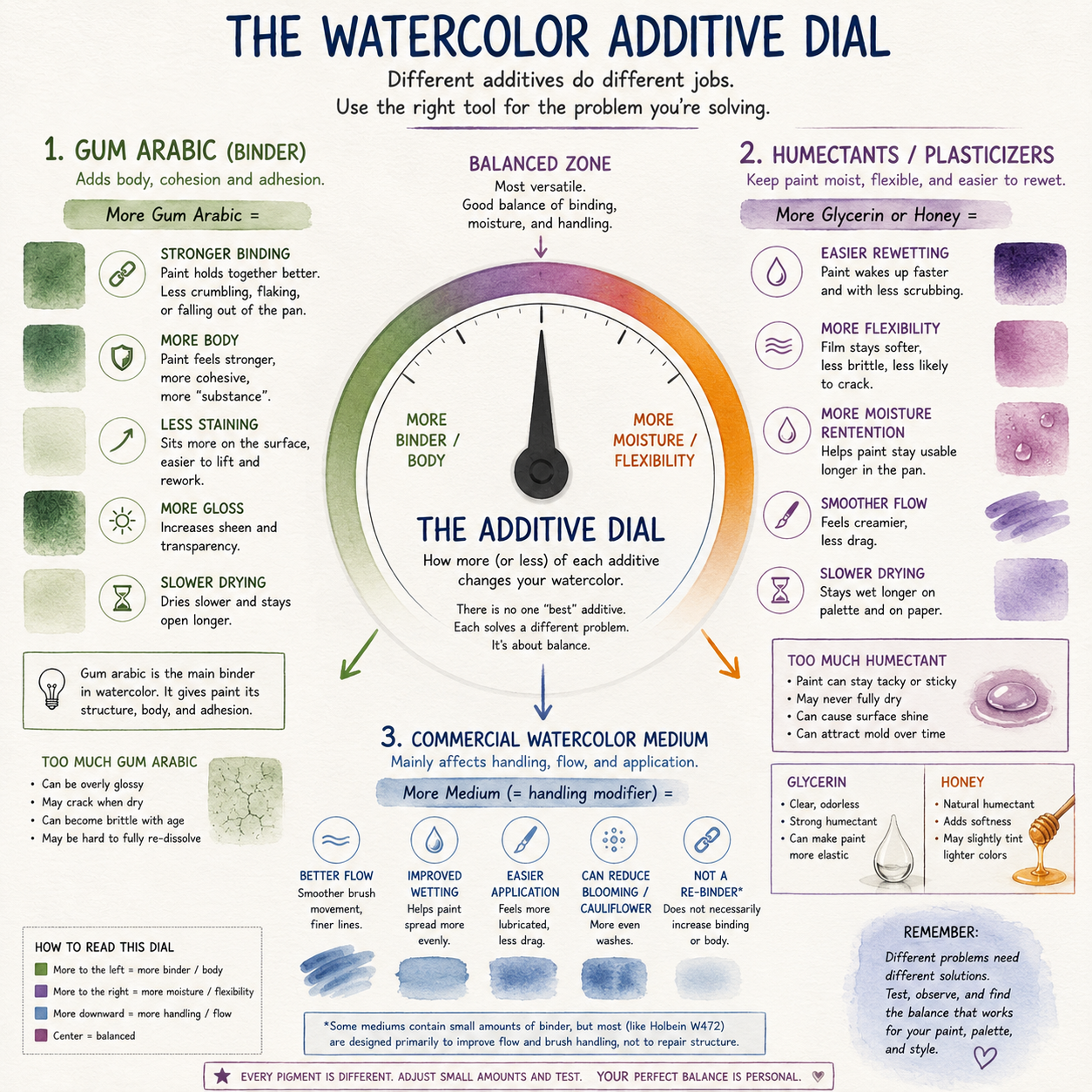
Gum Arabic (Binder)
Gum arabic is the traditional binder used in watercolor paint. Its job is to hold pigment particles together and help them adhere to the paper.
Generally speaking, more binder can:
✔ Improve cohesion and body
✔ Reduce crumbling
✔ Make paint easier to lift later
But too much can also:
✘ Increase gloss
✘ Create a harder paint cake
✘ Alter handling
Product tested: Holbein Gum Arabic Medium
https://tinyurl.com/n924yar5
Glycerin and Honey (Humectants)
Glycerin and honey belong to a different category called humectants.
Their primary role is to:
✔ Retain moisture
✔ Improve rewetting
✔ Keep paints softer and more flexible
This is why brands like M. Graham are known for their easy rewetting characteristics.
However, humectants can also introduce tradeoffs:
✘ Increased gloss
✘ Tackiness
✘ More difficult lifting in some cases
Watercolor Mediums
Not all watercolor mediums are the same.
The Holbein Watercolor Medium I tested is marketed primarily as a flow and handling aid rather than a paint-making binder.
In other words, it may affect how the paint behaves under the brush without necessarily solving a structural problem.
Product tested: Holbein Watercolor Medium
https://tinyurl.com/4dwbnfh8
What Surprised Me Most

Honestly?
The control sample performed far better than I expected.
After comparing:
Control (water only)
Gum Arabic Medium
Watercolor Medium
Glycerin
Honey
Too Much Glycerin
I found that some additives improved rewetting, but often introduced other compromises.
The most useful insight from the test was this:
Easy rewetting does not automatically mean better paint.
Some of the samples that rewet most easily also became glossier, tackier, or more difficult to lift from the paper.
My Personal Conclusion
If I were trying to rescue a flaky pan of Prussian Blue, I would probably do one of two things:
Option 1: Do Nothing
Surprisingly, the control remained one of the cleanest and most predictable samples throughout the test.
For a pigment like Prussian Blue, I may simply choose to squeeze out fresh paint when needed.
Option 2: Use a Small Amount of Gum Arabic Medium
Of all the additives I tested, the Holbein Gum Arabic Medium felt like the best compromise.
It improved cohesion without introducing as many side effects as some of the other options.
That doesn't make it a universal fix, but it was the one I felt most comfortable painting with.
The Bigger Lesson
What started as a search for the "best additive" turned into something much more interesting.
Watercolor formulation is a balancing act.
Some artists prioritize:
Fast rewetting
Soft pans
Creamy paint
Others prioritize:
Stability
Clean drying
Easy lifting
Predictable handling
Neither approach is wrong.
The real question is:
What do you value most in your watercolor paints?
Supplies Mentioned
Prussian Blue (test pigment)
https://tinyurl.com/mpz7ayu8
Holbein Gum Arabic Medium
https://tinyurl.com/n924yar5
Holbein Watercolor Medium
https://tinyurl.com/4dwbnfh8
If you have not watched the video, its here!